


Solar Feature Identification
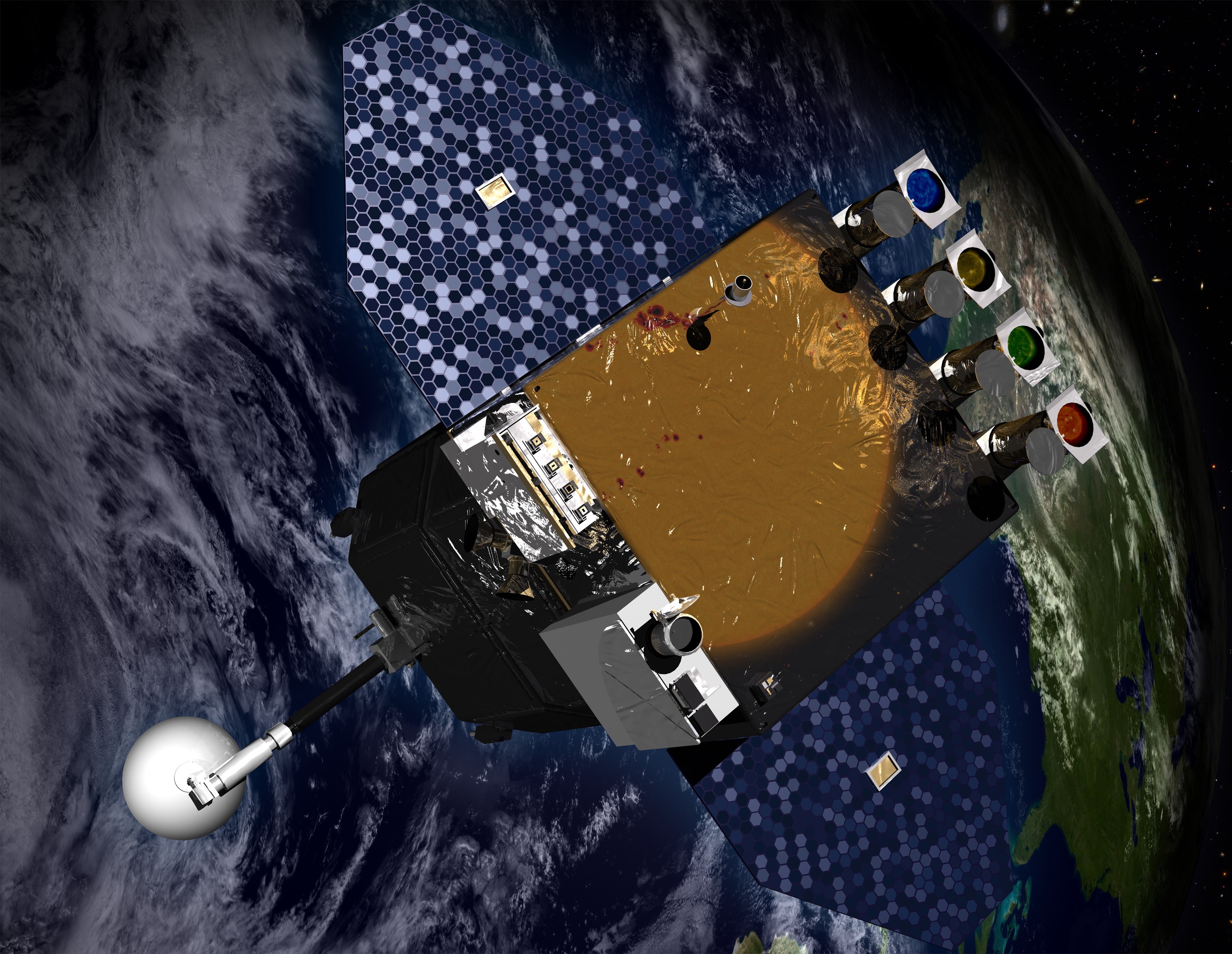
Two successive solar
observatories, SDO (2010-present, shown) and SOHO (1996-2011)
retrieved high-resolution spectral and magnetic-field images. We developed
Bayesian methods to identify solar active regions and
related structures, and to track them through a series
of images, resulting in several mission data products.
Read more
The Uncertainty Quantification and Statistical Analysis Group carries out research and technology development in computational techniques to extract knowledge from science data.
What we do: Model the statistical variability of physical systems like oceans and atmospheres; infer parameters, recognize patterns, and quantify uncertainty in massive data sets taken from such systems.
Uncertainty Quantification
- Uncertainty quantification (UQ) for retrievals from Earth-observing instruments including OCO-2, MLS, ECOSTRESS, and MAIA
- Uncertainty assessment and propagation for a large-scale hydrological routing model, and uncertainty assessment for groundwater using models and gravimetric observations
Statistical Data Fusion and Science Data Analysis
- Spatial and spatio-temporal data fusion for atmospheric fields in a Bayesian context, with applications to near surface temperature products from AIRS
- Developed a leading system for recognizing, grouping, and tracking solar active regions used for SOHO and distributed as a data product for SDO
- Proprioceptive and appearance-based terrain classification for autonomous rover navigation (DARPA, ARO)
- Developed multi-observation compressed summaries for MISR and AIRS, which have been distributed as a Level 3 data product
- Developing new statistical methods for assessing agreement between Earth system model simulations and observations in a distributed data context
Physical Modeling and Advanced Inversion Algorithms
- Inversion of cosmic microwave background to recover spherical harmonic power, and structural parameters of cosmological models (Wilkinson Microwave Anisotropy Probe and Planck)
- Data assimilation and Bayesian risk assessment for highly nonlinear weather systems